

Description
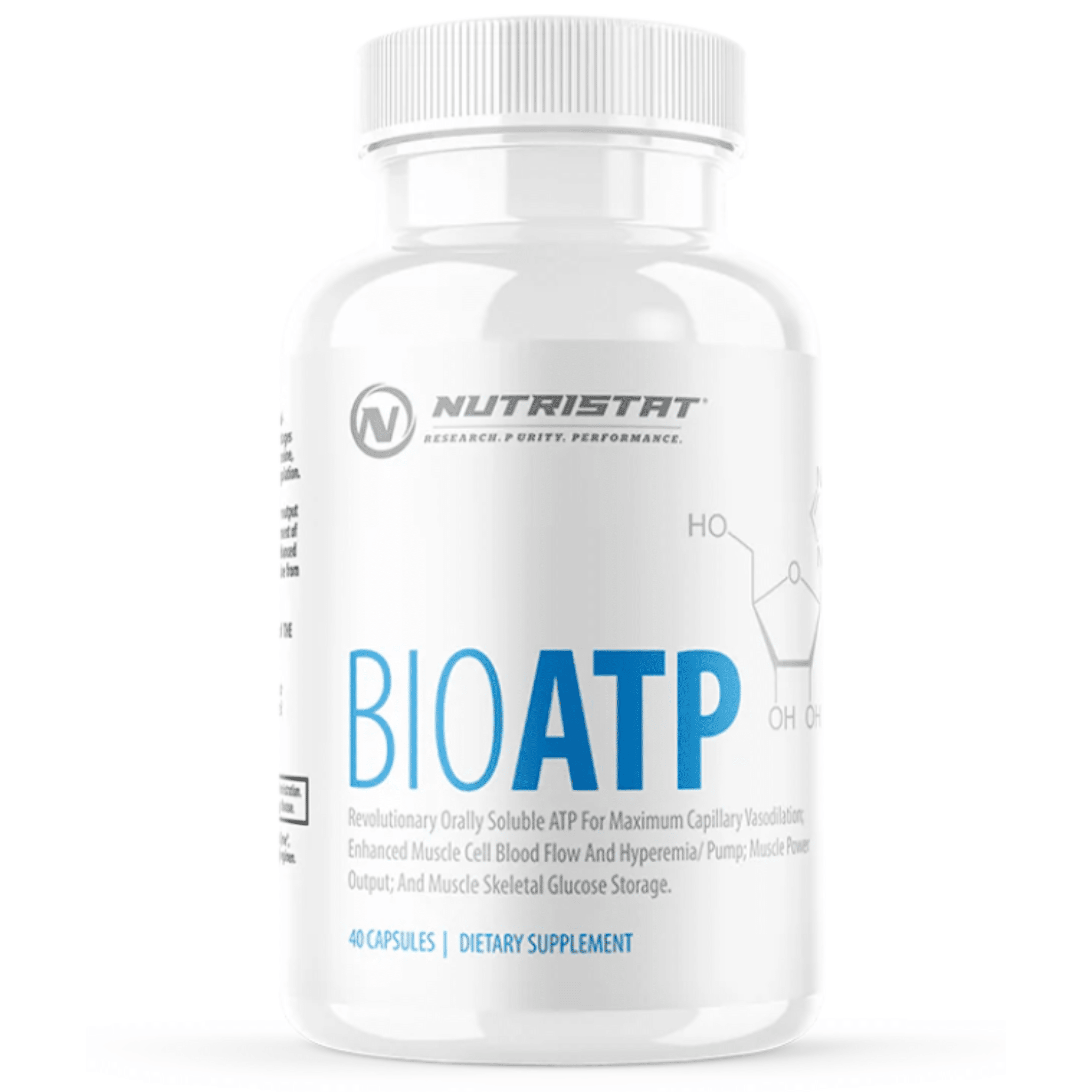
Nutristat Bio ATP
Adenosine triphosphate as Peak ATP, for power output, blood flow and recovery between efforts.
⚠ The counterintuitive part: swallowed ATP does not become cellular fuel
This is the single most important thing to understand about the product, and getting it wrong is why people dismiss the category.
ATP is your cells' immediate energy currency — every muscle contraction is powered by splitting it. So the obvious assumption is that swallowing ATP gives your muscles more fuel.
It does not, and it cannot. Oral ATP is broken down in digestion, and even if it survived, ATP does not cross cell membranes. Your muscles cannot import it. They manufacture their own, continuously, from food.
So how does it work at all?
Because ATP has a second job outside the cell. Extracellular ATP is a genuine signalling molecule — it binds purinergic receptors on the surface of blood vessel walls and other tissues, triggering responses that have nothing to do with supplying energy.
The main documented effect is vasodilation. Extracellular ATP signals blood vessels to widen, increasing blood flow to working muscle. That is a completely different mechanism from fuelling a contraction — and it is why a 400mg dose can do something when your body turns over its own bodyweight in ATP daily.
Once you understand that, the product makes sense. It is a blood flow and signalling supplement that happens to use ATP as the messenger, not an energy supplement.
What the research examined
Peak ATP is one of the better-researched branded ingredients in this space, and the outcomes are worth knowing because they follow the mechanism:
- Power output and peak force, particularly across repeated sets
- Reduced fatigue over multiple bouts — the effect appears more clearly in later sets than in the first
- Blood flow and vasodilation, which is the primary mechanism
- Body composition and lean mass in longer training studies
- Recovery between efforts, consistent with the blood flow effect
Note the pattern: the benefits cluster around repeated efforts rather than a single maximal one. That fits a blood flow mechanism precisely — better perfusion matters most when you are asking a muscle to perform again and again.
An honest read on the evidence
Peak ATP has real human research behind it, which is more than most novel ingredients can say, and the dosing in studies is consistent.
The caveats we would want you to know:
- Much of the research is funded by the ingredient manufacturer. That is normal in this industry and does not invalidate it, but independent replication is thinner
- Effect sizes are modest. This is a marginal-gains ingredient, not a transformative one
- It is expensive per serving relative to the fundamentals
Our position: a legitimate, mechanistically sensible ingredient for someone who already has training, protein and creatine in order. Not a first purchase.
⚠ Take it on an empty stomach
This matters more here than with most supplements.
ATP is degraded by digestive processes, and food makes that worse. Research protocols typically use it fasted, 30 minutes before training, and that is the sensible way to take it.
Taking Peak ATP with a meal substantially undermines the point of buying it.
Specs
| Peak ATP | Adenosine 5'-triphosphate disodium |
| Mechanism | Extracellular signalling and vasodilation, not cellular fuel |
| Stimulants | None |
| Take | Fasted, 30 minutes before training |
The researched dose is 400mg daily, which is what the studies used. Check your tub matches — a smaller amount is below what was tested.
How it fits with pump products
Bio ATP works through a genuinely different route from the usual pump ingredients, which makes it additive rather than duplicative:
| Citrulline | Raises arginine, feeding nitric oxide synthase |
| Nitrates | Reduced to nitrite then nitric oxide, bypassing that enzyme |
| Peak ATP | Purinergic receptor signalling — a third pathway entirely |
It stacks cleanly with citrulline or a nitrate product, and it is stimulant-free so it goes alongside any pre-workout.
How to take it
- 400mg daily, on an empty stomach, about 30 minutes before training.
- Daily rather than only on training days — the longer studies used consistent daily dosing.
- Not with food. This is the easiest thing to get wrong.
- Give it several weeks. The body composition and power findings come from multi-week protocols.
- Stimulant-free, so it stacks with anything.
Who this is for
- Anyone doing high-volume training with repeated sets — where the effect appears most clearly
- Strength and power athletes managing performance across a session
- People who already have training, protein and creatine sorted and want a marginal gain
- Anyone wanting a blood flow pathway their pre-workout does not cover
- People who cannot take stimulants
Who this is not for
Anyone expecting an energy effect. Oral ATP does not become cellular fuel — it is a signalling molecule, and you will not feel it.
Anyone on a limited budget. Creatine works on the same phosphate energy system, has decades more evidence, and costs a fraction as much. Buy that first.
Anyone taking it with meals, which wastes most of it.
Anyone wanting an acute, noticeable effect — this is a multi-week proposition.
Not for anyone under 18, pregnant or nursing.
Stack it with: creatine — the two work on related systems by different mechanisms, and creatine is the one with the deeper evidence.
Frequently asked questions
Does swallowing ATP give my muscles more energy?
No. Oral ATP is broken down in digestion, and ATP cannot cross cell membranes anyway — your muscles make their own. It works as an extracellular signalling molecule instead.
So what does it actually do?
Extracellular ATP binds purinergic receptors on blood vessel walls, triggering vasodilation and increased blood flow to working muscle.
Why is 400mg enough?
Because it is signalling rather than fuelling. A messenger needs only to be detected, not to supply the energy itself.
When should I take it?
Fasted, about 30 minutes before training. Food degrades it and substantially reduces the effect.
Will I feel it?
No. It is stimulant-free and the effects are measured rather than sensed — mainly in later sets rather than the first.
How long before it works?
The power and body composition findings come from multi-week protocols, so give it several weeks of consistent use.
Can I take it with my pre-workout?
Yes, and it works through a different pathway from citrulline or nitrates — so it is additive rather than duplicative.
Is it better than creatine?
No. Creatine has decades more evidence and costs a fraction as much. Buy creatine first; consider this once that is in place.
You may also like
Recently viewed
- Opens in a new window.