

Description
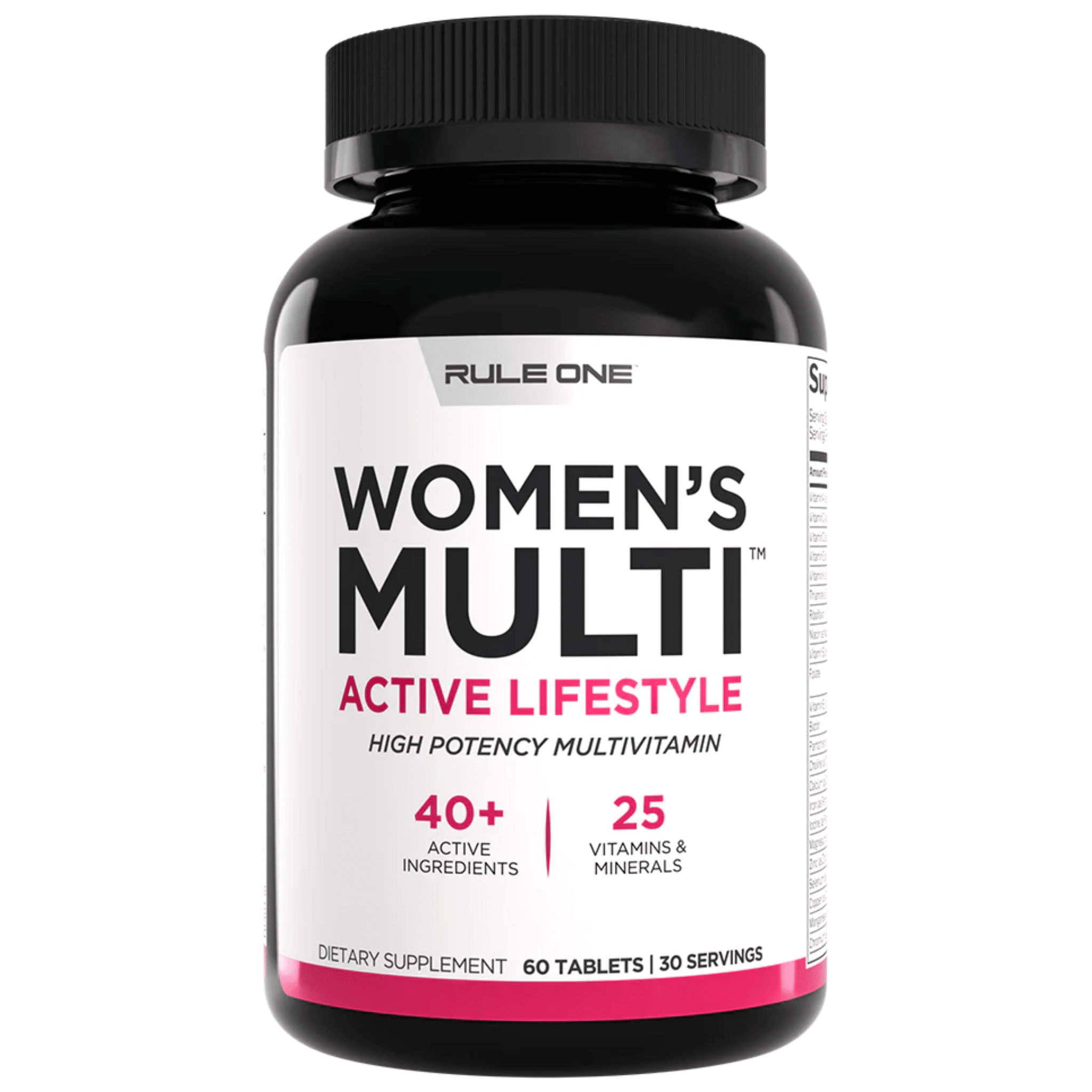
Rule One Women's Train Daily
Over 40 active ingredients including 25 vitamins and minerals, in a two-tablet daily serving. Zero calories, zero sugars, zero banned substances.
The differences from the men's version are real and worth understanding, because "for women" on a multivitamin is usually just marketing.
Iron is the actual difference, and it matters
This is the single most important distinction between a men's and a women's multivitamin, and it is not cosmetic.
Menstruating women lose iron every month. That ongoing loss means requirements are substantially higher than for men — roughly 18mg daily against 8mg — and iron deficiency is one of the most common nutritional deficiencies worldwide, disproportionately affecting women of reproductive age.
Iron carries oxygen in the blood as part of haemoglobin. Low iron shows up as fatigue, breathlessness during exercise, and poor training capacity — symptoms that are easy to attribute to poor sleep or overtraining when the cause is nutritional.
This is also why men's multivitamins usually contain no iron at all. Men have no routine iron losses, and iron accumulates rather than being readily excreted. That is not an oversight in the men's formula; it is deliberate.
Which leads to the important caution below.
⚠ Iron warnings that are not boilerplate
Accidental overdose of iron-containing products is a leading cause of fatal poisoning in children under six. That warning appears on the label because it is true. Keep this out of reach of children, and treat it with the same care you would a medication.
Do not take an iron-containing multivitamin without knowing you need iron. Post-menopausal women, and anyone with haemochromatosis or another iron-overload condition, should not supplement iron routinely. If you are not menstruating, an iron-free multivitamin may be the more appropriate choice — Men's Train Daily is not sex-specific in any meaningful way beyond the iron, and plenty of women take it for exactly that reason.
A simple blood test tells you your iron status. If you are unsure, ask your doctor rather than guessing. That is the honest answer and it applies in both directions.
What else is in it
- 25 vitamins and minerals, including 200% of the daily value for vitamin D3
- Folate — essential for cell division and DNA synthesis, and the reason it is emphasised in women's formulas, since requirements rise substantially in early pregnancy, often before pregnancy is known
- Calcium — women have a higher lifetime risk of bone density loss, making intake more consequential
- Cranberry — the proanthocyanidins in cranberry are studied for urinary tract support
- Isoflavones — plant compounds with a weak structural similarity to estrogen
- Silica — included for hair, skin and nails
- Antioxidant vitamins A, C and E, a carotenoid complex, superfood concentrates and botanical extracts
Women's or Men's Train Daily?
| Women's | Men's | |
| Serving | 2 tablets | 3 tablets |
| Active ingredients | 40+ | 50 |
| Vitamins & minerals | 25 | 24 |
| Iron | Yes | No |
| Vitamin D3 | 200% DV | 37.5mcg |
| Distinctive additions | Cranberry, isoflavones, silica | Amino acids, digestive enzymes |
| Servings per bottle | 30 (60 tablets) | 60 (180 tablets) |
The honest guide: if you menstruate, the iron makes the women's version the right choice. If you do not — post-menopause, or for any other reason — the men's version is a perfectly sensible option and avoids iron you may not need.
Take it with food, and this genuinely matters
Vitamins A, D, E and K are fat-soluble and require dietary fat to be absorbed. Taken on an empty stomach, a meaningful share passes straight through. The carotenoid complex needs the same conditions.
One additional note specific to iron: vitamin C improves iron absorption, and this formula contains it. Meanwhile calcium competes with iron for absorption — so if you also take a separate calcium supplement, space it a couple of hours apart from this.
Tea and coffee also inhibit iron absorption through their tannin content. Taking an iron-containing multivitamin with your morning coffee works against it.
Specs
| Serving size | 2 tablets |
| Servings | 30 (60 tablets) |
| Active ingredients | 40+ |
| Vitamins and minerals | 25 |
| Vitamin D3 | 200% DV |
| Calories / sugars | Zero |
| Banned substances | None |
| Allergen | Contains soy |
| Manufacturing | GMP facility |
How to take it
- Two tablets daily with a meal containing some fat.
- Together or split across two meals. Either works; splitting is marginally better for water-soluble vitamins.
- Not with coffee or tea, which inhibit iron absorption.
- Space it from any separate calcium supplement.
- Every day. Micronutrient status builds over weeks.
- Expect bright yellow urine from riboflavin. Harmless and universal with B-complex products.
Who this is for
- Menstruating women training hard, where iron losses and demand both rise
- Anyone in a deficit, where lower food volume means fewer micronutrients
- Women who suspect low iron and want a sensible baseline while getting it checked
- Anyone who wants more than a supermarket one-a-day at a reasonable price
Who this is not for
Not for pregnant women, women trying to conceive, or nursing — this is on Rule One's label. Prenatal formulations exist for a reason and the nutrient requirements differ meaningfully. Speak to your doctor.
Not for anyone who does not need iron. Post-menopausal women, or anyone with an iron-overload condition, should not routinely supplement it. Consider the men's version instead.
Contains soy, and is made on equipment processing milk, wheat, egg, fish, shellfish, tree nuts and peanuts.
If your diet is genuinely varied with plenty of produce, you may not need a multivitamin at all.
Stack it with: a fish oil, since omega-3s are not in here in meaningful amounts, and creatine — which women are routinely and wrongly advised to avoid. See our creatine range.
Frequently asked questions
Why does the women's multivitamin contain iron and the men's does not?
Menstruating women lose iron monthly, so requirements are roughly 18mg daily against 8mg for men. Men have no routine losses and iron accumulates rather than being readily excreted, so leaving it out of a men's formula is deliberate.
Should I take it if I am post-menopausal?
Possibly not. Without monthly losses, routine iron supplementation is not usually appropriate. The men's version is iron-free and otherwise comparable. Ask your doctor if you are unsure.
Can I take it while pregnant?
No. Rule One states it is not for women who are pregnant, trying to conceive, or nursing. Prenatal formulations differ meaningfully — speak to your doctor.
Why not with coffee?
Tannins in tea and coffee inhibit iron absorption. Take it with a meal instead.
Does vitamin C help?
Yes, it improves iron absorption and is included in the formula. Calcium does the opposite, so space any separate calcium supplement a couple of hours apart.
Why is my urine bright yellow?
Riboflavin. Water-soluble, dosed above the daily value, and the excess is excreted. Harmless.
Can men take the women's version?
They can, but the iron is not needed and accumulates over time. The men's version is the better fit.
How is it different from a supermarket multivitamin?
Higher potencies plus superfood concentrates, botanical extracts, isoflavones and silica. A two-tablet serving also allows more material than a single one-a-day physically can.
You may also like
Recently viewed
- Opens in a new window.