


Description
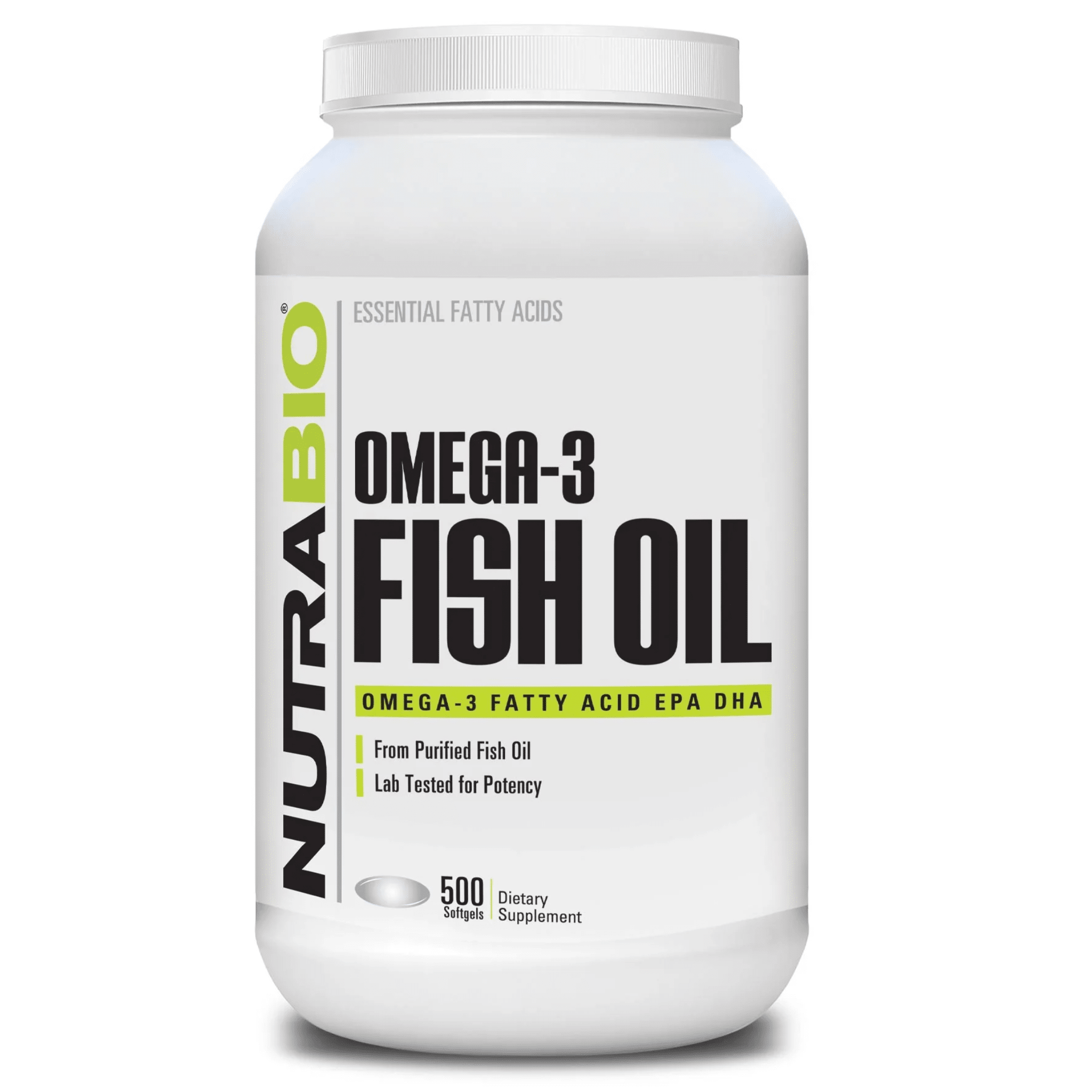
NutraBio Omega-3 Fish Oil
Fish oil softgels supplying EPA and DHA, fully disclosed with no proprietary blends. 500 softgels.
⚠ How to read a fish oil label — the number on the front is not the number that matters
This is the most useful thing on this page, and it applies to every fish oil on every shelf.
Fish oil products advertise the total fish oil weight. That is not the active content.
A typical softgel might contain 1,000mg of fish oil — but fish oil is a mixture of many fatty acids, and only two of them are the ones with the research behind them: EPA and DHA. In a standard fish oil, those two together account for roughly 300mg of that 1,000mg.
So the question to ask of any fish oil is: how much combined EPA and DHA per serving? That number is on the panel, beneath the fish oil total. Everything else is other fatty acids and oil.
| "1,000mg fish oil" | Typically ~300mg EPA + DHA |
| Concentrated fish oils | Can reach 500–800mg EPA + DHA per gram |
| What to compare | Combined EPA + DHA, and cost per gram of it |
Once you compare on that basis, the price rankings between products often reverse completely.
EPA and DHA do different jobs
Worth knowing, because it affects what you should look for.
- EPA (eicosapentaenoic acid) — the anti-inflammatory one. It competes with omega-6 arachidonic acid as a substrate for the enzymes producing inflammatory signalling molecules, and the resulting compounds are less inflammatory. This is where the joint, muscle soreness and mood research concentrates
- DHA (docosahexaenoic acid) — the structural one. DHA is a major structural component of brain grey matter and the retina, incorporated directly into cell membranes. The brain and eye research centres here
Most people benefit from both, which is why standard fish oil supplying both is a sensible default rather than a specialised high-EPA or high-DHA product.
Why this is one of the genuinely worthwhile supplements
We are sceptical about most of this shelf. Fish oil is among the exceptions, for a straightforward reason: most people's diets are genuinely imbalanced.
Omega-6 and omega-3 fatty acids compete for the same enzymes. Modern diets are heavy in omega-6 — seed oils, processed food, grain-fed meat — and light in omega-3, which comes mainly from oily fish.
The result is a ratio skewed far from what human physiology evolved with. Correcting that is the real argument for fish oil, and it is a structural argument rather than a marketing one.
If you eat oily fish two or three times a week, you likely do not need this. Most people do not.
⚠ The freshness question nobody mentions
Fish oil goes rancid. Polyunsaturated fats oxidise readily, and oxidised fish oil is not merely ineffective — it delivers oxidised lipids you would rather not consume.
How to tell:
- Bite a softgel occasionally. Fresh fish oil tastes mildly of fish. Rancid fish oil tastes sharply unpleasant and distinctly "off"
- Strong fish burps are often a rancidity signal, not simply an inherent property of fish oil
- Store it in the fridge once opened. Heat and light accelerate oxidation, and a 500-count bottle will be open for a long time
- Check the expiry date and buy a size you will finish
Third-party testing matters here too — oxidation markers are among the things a good lab test looks at.
Specs
| Fish oil | Supplying EPA and DHA — check the panel for the combined figure |
| Softgels | 500 |
| Label | Fully disclosed, no proprietary blends |
| Testing | Third-party tested, published at checkmysupps.com |
| ⚠ Allergen | Fish |
How to take it
- With a meal. Fat-soluble, and food substantially improves absorption.
- Split across meals if you take several softgels.
- Aim for a combined EPA + DHA target rather than a softgel count. General health intakes commonly cited sit around 250–500mg daily; higher intakes are used for joint and triglyceride purposes.
- Refrigerate after opening, particularly a 500-count bottle.
- If you get fish burps, take it with a larger meal, or freeze the softgels — that genuinely helps.
- Daily. Omega-3 status changes over months as fatty acids incorporate into cell membranes.
Who this is for
- Anyone who does not eat oily fish two or three times a week — which is most people
- People with joint discomfort, where EPA's anti-inflammatory role is most relevant
- Anyone training hard, given the muscle soreness and recovery research
- People with cardiovascular considerations
- Anyone eating a diet heavy in seed oils and processed food
Who this is not for
Anyone with a fish allergy. Algae-based omega-3 is the alternative, and it supplies DHA directly.
Anyone taking blood thinners, without medical advice. Omega-3 affects platelet aggregation, and this is a genuine interaction rather than a formality.
Anyone about to have surgery — discontinue two weeks beforehand.
Vegans and vegetarians — algae oil is the alternative.
If you already eat oily fish regularly, you may not need it.
Not for anyone under 18, pregnant or nursing without medical advice.
Stack it with: vitamin D and CoQ10 — all three are fat-soluble, all three are taken with the same meal, and together they cover the most commonly low nutrients in active adults.
Frequently asked questions
How do I compare fish oils?
On combined EPA plus DHA per serving, not on the fish oil total. A 1,000mg fish oil softgel typically supplies around 300mg of EPA plus DHA.
What is the difference between EPA and DHA?
EPA is the anti-inflammatory one, where joint and mood research concentrates. DHA is structural, forming part of brain and retinal cell membranes.
How much should I take?
Aim for a combined EPA plus DHA target rather than a softgel count. Commonly cited general health intakes are around 250–500mg daily, with higher amounts used for joint and triglyceride purposes.
Why do I get fish burps?
Often a rancidity signal rather than an inherent property. Take it with a larger meal, refrigerate the bottle, or freeze the softgels.
Does fish oil go off?
Yes. Polyunsaturated fats oxidise readily. Bite a softgel occasionally — fresh tastes mildly of fish, rancid tastes sharply unpleasant. Refrigerate after opening.
Should I take it with food?
Yes. It is fat-soluble and food substantially improves absorption.
Do I need it if I eat fish?
If you eat oily fish two or three times a week, probably not. Most people do not.
Is there a vegan option?
Algae oil, which supplies DHA directly — and is in fact where the fish get theirs.
Omega-3 fish oil softgels with EPA and DHA praised for quality and affordability. Customers said "no digestion issues or upset stomach ever" and appreciated "top-notch brands with quality ingredients." One review gave 1 star but positive text. Fast shipping and excellent customer service consistently noted.
- 5 stars: 9 (90%)
- 4 stars: 0 (0%)
- 3 stars: 0 (0%)
- 2 stars: 0 (0%)
- 1 star: 1 (10%)
Great product better price even with shipping to Fla.
I placed my order on a Friday and everything was at my door Monday!! Plus a hand written note was a super awesome touch!! Thank you!
Affordable pricing for top-notch brands that provide formulas with quality ingredients and ratios of each as such; variety of supplements and vitamins in their pure forms
Great price! My husband and I both are taking it. We started with two a day and then increased to three. No stomach issues 😁
Nutra Bio- Omega 3 Fish Oil
Great service as always
Nutra Bio- Omega 3 Fish Oil
This place has to be the best nutrition store in the area. The employees are incredibly knowledgeable and super helpful.
10/10
My go-to fish oil! No digestion issues or upset stomach ever.
You may also like
Recently viewed
- Opens in a new window.