

Description
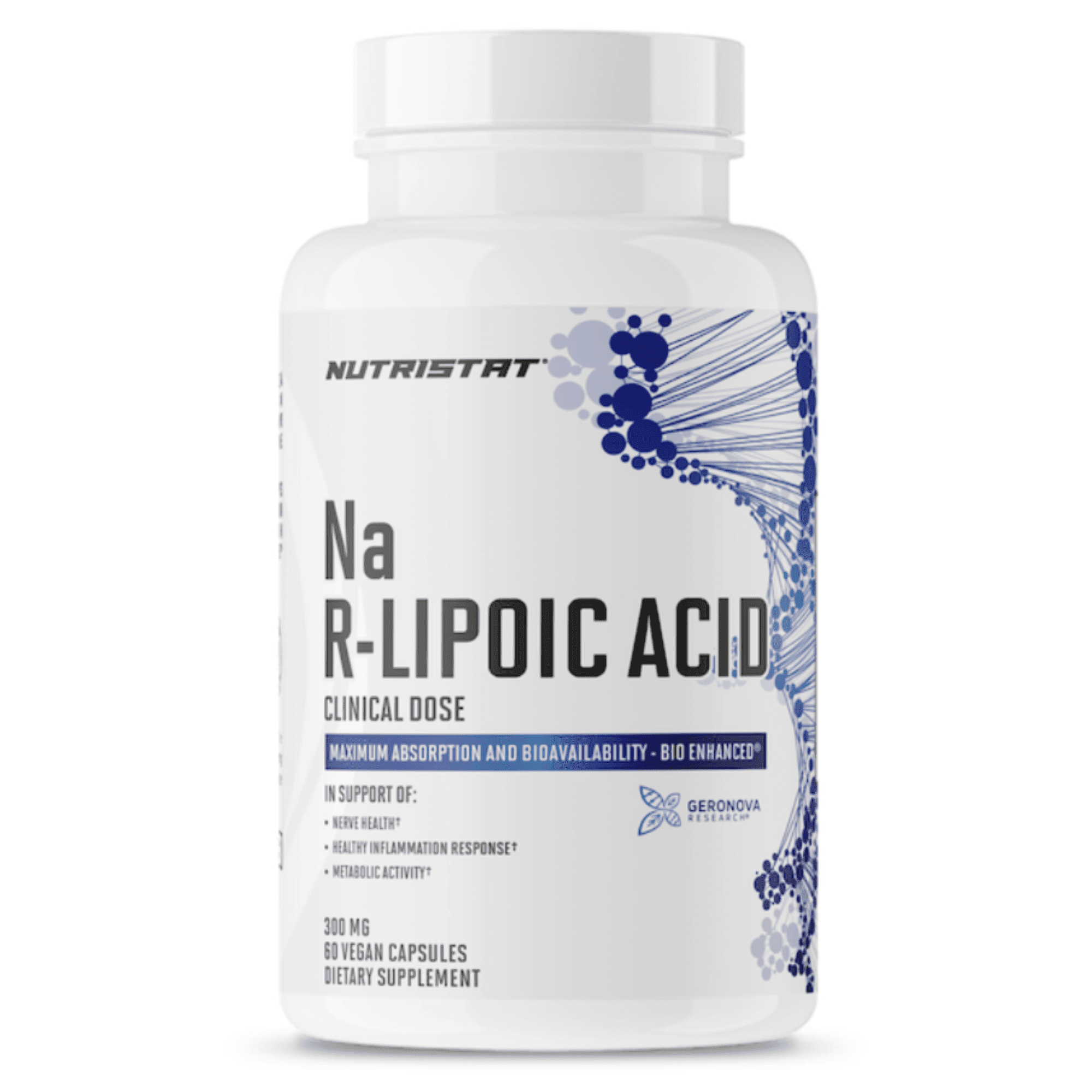
Nutristat R-Lipoic Acid
R-lipoic acid — the biologically active isomer, rather than the standard racemic alpha-lipoic acid.
⚠ R versus standard ALA: the distinction worth paying for
This is the entire point of the product, and it is a genuine one rather than a marketing angle.
Alpha-lipoic acid exists in two mirror-image forms — R and S. They are chemically identical in composition but opposite in three-dimensional structure, like a left and right hand.
Only the R form occurs in nature. Your body synthesises R-lipoic acid, your enzymes use R-lipoic acid, and it is R-lipoic acid that functions as a cofactor in mitochondrial energy metabolism.
The S form is a by-product of chemical synthesis. Manufacturing lipoic acid in a laboratory produces a roughly 50/50 mixture of both, and that mixture is what "alpha-lipoic acid" on a label usually means.
| "600mg Alpha-Lipoic Acid" | Typically ~300mg R-form, ~300mg S-form |
| R-Lipoic Acid | All of it is the active form |
So half of a standard ALA capsule is the isomer your body did not evolve to use. Worse, there is evidence the S form may partially interfere with the R form's activity — meaning the racemic mixture is not simply half as good.
This is the same shape of problem as the alpha-GPC and eurycomanone standardisation issues elsewhere in our catalogue. The number on the front is not the number that matters.
What lipoic acid actually does
Lipoic acid is unusual among antioxidants, for a specific reason.
Most antioxidants work in either water or fat, not both. Vitamin C is water-soluble and works in blood and cell fluid; vitamin E is fat-soluble and works in membranes.
Lipoic acid is soluble in both. That means it operates in every compartment of the cell — including inside mitochondria, where a great deal of oxidative stress originates.
And it regenerates other antioxidants. Lipoic acid can recycle vitamin C, vitamin E and glutathione back into their active forms after they have been used. That amplifying role is why it is sometimes called a "universal antioxidant".
Its other well-researched area is glucose metabolism — lipoic acid has been studied in relation to insulin sensitivity and glucose uptake, which is why it appears in glucose disposal products alongside ingredients like those on our Berberine X5 page.
It also has a substantial research history in diabetic peripheral neuropathy, where it has been used clinically in some countries.
⚠ Practical notes and cautions
Take it on an empty stomach. Food substantially reduces lipoic acid absorption — this matters more than with most supplements, and it is free to get right. Thirty minutes before a meal, or two hours after.
R-lipoic acid is less stable than the racemic form, which is why it is often sold as a stabilised sodium salt. Store it somewhere cool and dry, and avoid heat.
⚠ It lowers blood glucose. That is one of its mechanisms, and it means:
- Anyone diabetic or on glucose-lowering medication should speak to their doctor first. Combining it with metformin, sulfonylureas or insulin carries a genuine hypoglycaemia risk
- Anyone not diabetic should still be alert to lightheadedness on an empty stomach
⚠ It also chelates metals. Lipoic acid binds minerals, so take it away from iron, zinc, magnesium and calcium supplements by a couple of hours.
Thiamine. Long-term lipoic acid use has been associated with thiamine (B1) depletion in some contexts. A B-complex covers that.
Specs
| R-Lipoic Acid | The active isomer only |
| Stimulants | None |
| Take | On an empty stomach |
How to take it
- On an empty stomach — 30 minutes before food or two hours after.
- Away from mineral supplements by a couple of hours, since lipoic acid chelates metals.
- Split larger amounts across the day; lipoic acid clears quickly.
- Store cool and dry.
- ⚠ Speak to your doctor first if you take anything affecting blood glucose.
Who this is for
- Anyone interested in glucose metabolism and insulin sensitivity
- People wanting a genuinely broad-spectrum antioxidant that works in both water and fat compartments
- Anyone who would rather pay for the active isomer than a 50/50 mixture
- People taking it alongside a glucose disposal protocol
Who this is not for
⚠ Anyone diabetic or on glucose-lowering medication, without medical supervision.
Anyone with a thyroid condition — lipoic acid may affect thyroid hormone conversion. Check with your doctor.
Anyone taking it with meals or alongside minerals, which wastes much of it.
Athletes taking it purely as a training antioxidant should note the same caveat as on our NAC page — blunting exercise-induced oxidative stress may also blunt some adaptation. Taking it away from your workout is the cautious approach.
Anyone about to have surgery — discontinue two weeks beforehand.
Not for anyone under 18, pregnant or nursing.
Stack it with: a B-complex for the thiamine, taken at a different time of day.
Frequently asked questions
What is the difference between R-lipoic acid and alpha-lipoic acid?
Standard ALA is a roughly 50/50 mixture of R and S isomers. Only the R form occurs in nature and is used by your enzymes — so half of a standard capsule is the form your body did not evolve to use.
Is it worth the extra cost?
If you are comparing like for like, a smaller dose of R-lipoic acid delivers the same active amount as roughly double the racemic form — and there is evidence the S isomer may partially interfere with the R form's activity.
Why is it called a universal antioxidant?
It is soluble in both water and fat, so it works in every cell compartment — and it regenerates vitamin C, vitamin E and glutathione back into their active forms.
Should I take it with food?
No. Food substantially reduces absorption. Take it 30 minutes before a meal or two hours after.
Can I take it with diabetes medication?
Not without medical supervision. Lipoic acid lowers blood glucose, and combining it with glucose-lowering medication carries a hypoglycaemia risk.
Can I take it with my minerals?
Space them a couple of hours apart — lipoic acid chelates metals and will bind them.
Does it need special storage?
R-lipoic acid is less stable than the racemic form. Keep it cool and dry, away from heat.
Should I take extra thiamine?
Long-term use has been associated with thiamine depletion in some contexts. A B-complex covers it, taken at a different time of day.
You may also like
Recently viewed
- Opens in a new window.